Skip to content

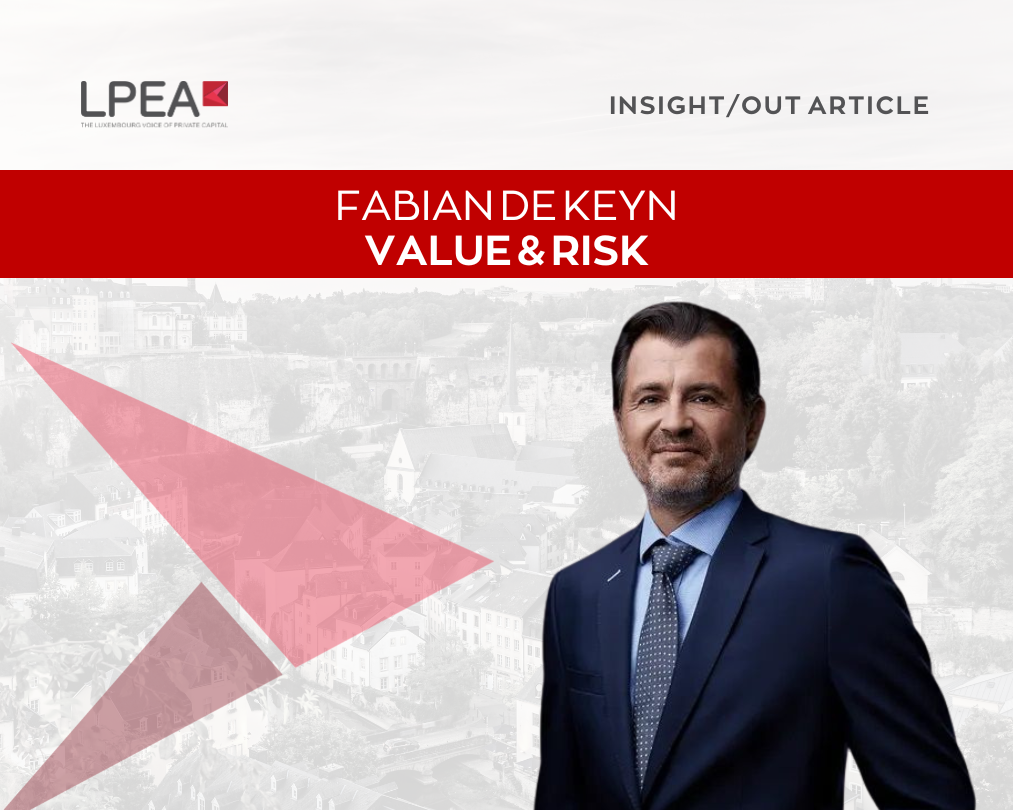
Article by Fabian De Keyn, Head of Valuation Services, Luxembourg at Value & Risk, as published in Insight/Out magazine #36.
A New Era for Fund Valuation
The world of fund valuation has entered a decisive new phase. Once dominated by straightforward equity and bond portfolios, today’s investment universe has grown exponentially in diversity and complexity. Private Debt, Infrastructure, Renewable Energy, Private Equity, and structured instruments have moved from the periphery to the core of institutional portfolios.
This shift has been transformative – offering investors new opportunities but also creating unprecedented challenges for those responsible for valuation. What was once a niche back-office function has become a strategic pillar of governance.
Fund valuation is no longer about assigning a number. It is about demonstrating transparency, consistency, and defensibility in a market environment defined by regulatory scrutiny and investor expectation.
The End of Simplified Approaches
Not long ago, valuation often meant relying on market comparables, price feeds, or simplified model assumptions. Those days are over.
Across Europe – and especially in Luxembourg – supervisory authorities have made it clear that such practices no longer meet the standard of “fair value.” Regulatory frameworks now require valuation processes that are structured, traceable, and evidence-based.
Valuation models must be technically validated and supported by market data, clear documentation, and expert judgment. In short, “black box” models have no place in today’s regulated environment.
For Alternative Investment Fund Managers (AIFMs), this evolution means that the valuation process must withstand not only market volatility but also regulatory and audit review. Transparency is no longer a differentiator – it is the baseline expectation.
Independence as the New Standard
The 2008 financial crisis changed how the financial world perceives independence. One of its lasting lessons is that valuation cannot be left solely in the hands of those with a commercial interest in the outcome.
Over the past decade, regulatory developments such as AIFMD and its upcoming successor, AIFMD II, have placed independence at the very centre of the valuation process. AIFMs are now required to ensure that valuation functions are free from conflicts of interest – whether performed internally or externally.
This evolution has encouraged a growing number of managers to entrust valuations to independent external specialists, combining impartiality with deep technical and regulatory expertise.
Independent valuation firms, such as Value & Risk, provide not only objective outcomes but also efficiency and credibility. They bridge the gap between regulatory expectations and operational realities – ensuring valuations are transparent, consistent, and defendable.
Regulation Redefining the Landscape
The AIFMD II directive marks a clear turning point. It reinforces governance requirements around the valuation process, emphasizes the need for robust internal controls, and increases oversight of outsourced functions.
Regulators such as the CSSF, BaFin, and ESMA are converging on a common goal: to ensure that valuation practices across Europe adhere to a consistent standard of independence, documentation, and methodological rigor.
This means that AIFMs and management companies must be able to demonstrate traceability from every valuation model back to the underlying data sources. Every assumption, parameter, and adjustment must be explainable and auditable – at any time.
In this new environment, valuation has evolved from a technical discipline to a core governance function.
Internal vs. External Valuation – A Strategic Choice
For many AIFMs, one key question defines their operating model: should valuation be managed internally, or delegated to a specialised external partner?
Internal valuation offers control and flexibility but requires significant resources – including infrastructure, expert staff, and constant regulatory alignment. Maintaining multiple data sources, validation layers, and audit documentation can become a heavy operational and compliance burden.
External valuation, in contrast, brings independence, scalability, and efficiency. By leveraging established infrastructures, standardized models, and experienced professionals, managers can focus internal capacity on oversight and strategic priorities.
Outsourcing also provides a safeguard against key-person dependencies, while ensuring that models remain compliant with evolving standards and local supervisory expectations.
The Technological Transformation
Technology has become a cornerstone of modern valuation. The integration of automation, data science, and artificial intelligence (AI) is reshaping how data is processed and analysed.
At Value & Risk, AI and natural language processing (NLP) are already being used to support data extraction, document parsing, and anomaly detection – tasks that previously required intensive manual input. These tools don’t replace human expertise; rather, they amplify it, freeing valuation professionals from repetitive tasks and allowing them to focus on what truly matters: professional judgment and model accuracy.
As the market evolves, AI-assisted transparency will redefine the valuation process. Real-time data validation, dynamic scenario testing, and automated stress analysis are no longer distant possibilities, they are becoming industry standards.
The result is not just faster valuation but smarter valuation, where every figure is underpinned by traceable data and verifiable logic.
The Luxembourg Perspective
Luxembourg, as one of Europe’s leading financial centres, plays a unique role in this evolution. With its high regulatory standards, international client base, and strong focus on alternative investments, the country is at the forefront of shaping modern valuation practices.
Luxembourg’s AIFMs face complex portfolios that often combine cross-border structures and multi-asset strategies. In this environment, the ability to deliver transparent, independent, and regulator-ready valuations is essential – not only to meet compliance standards but to preserve investor confidence.
This is precisely why Value & Risk expanded its presence to Luxembourg in 2024. Our goal was to be closer to our clients – AIFMs, management companies and custodians – and to provide local expertise supported by industrial-grade infrastructure.
Looking Ahead – From Compliance to Confidence
The coming years will redefine the role of valuation across the European fund industry. As AIFMD II takes effect and DORA introduces new standards for operational resilience, the emphasis will increasingly shift from compliance to confidence.
The firms that will lead this new era are those capable of combining human expertise with robust technology and uncompromising transparency.
For Value & Risk, this means continuing our mission: delivering valuations that are accurate, independent, and regulator-proof, while helping clients navigate an ever more complex investment landscape.
In a world where “what used to be enough no longer suffices,” the future belongs to those who embrace transparency as both a duty and a competitive advantage.