Skip to content

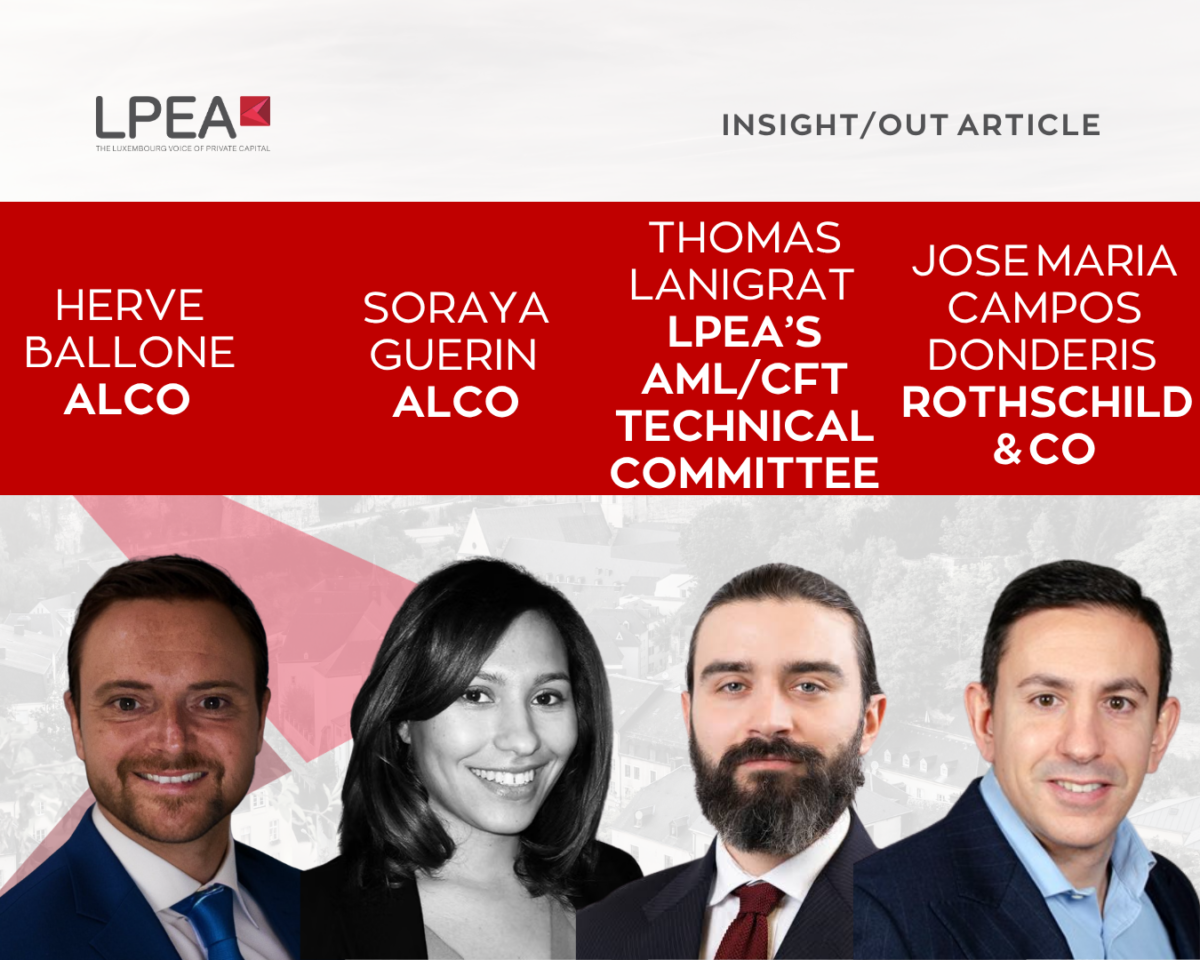
By Hervé Ballone, Co-Chairman of ALCO; Soraya Guerin, Board Member of ALCO; Thomas Lanigra, Co-chair of LPEA’s AML/CFT Technical Committee; and José Maria Campos Donderis, Head of R&Co IM Compliance at Rothschild & Co, as published in Insight/Out magazine #39.
From Q1 2027, compliance professionals working in Luxembourg’s alternative investment fund industry will have access to an AIFM compliance certification designed specifically for their sector. Delivered through the House of Training, it is the first joint initiative of the LPEA and Luxembourg’s Compliance Officers association (“ALCO”).
The ALCO certification pathway delivered through the House of Training (M1, M2, and M3) has for many years been the reference qualification for Compliance Officers across the Luxembourg financial centre. What has not been offered, until now, is a dedicated treatment of challenges faced by the compliance professionals working in alternative investment fund managers. This is the gap this new certification is intended to close when it launches in Q1 2027.
From generalist to specialist
The existing pathway does its job well: it builds a common base of knowledge that any Compliance Officer in Luxembourg needs, regardless of the type of entity they serve. The difficulty is that managers active in Private Equity, Real Estate, Private Credit, Venture Capital or fund of funds face a body of rules and a set of judgement calls that a cross-sector programme can only touch on in passing.
The examples are familiar to anyone working in an AIFM. AIFMD II has just reshaped delegation, liquidity management tools and loan origination, and a generalist module can describe the directive without walking through what an AIFM’s control framework must actually change.
AML/CFT supervision is also unique to AIFMs, as it sits with the CSSF or the AED depending on the vehicle, so one Compliance Officer often runs two supervisory relationships at once.
And finally, the business model itself can generate potential conflicts of interest in deal-making, (from co-investments to fee arrangements with portfolio companies) hardly seen in a UCITS context.
In each case the sector-specific application has so far been learned on the job.
A first collaboration between LPEA and ALCO
The new certification is the first project undertaken jointly by the LPEA, the voice of the Luxembourg alternative investment fund industry, and ALCO, the association representing Compliance Officers in Luxembourg and the reference body for compliance certification. The two bring complementary perspectives: one knows the business models and operating realities of the AIFMs concerned, the other has built and maintained the profession’s qualification standard for the market for many years.
The collaboration was built on a common objective. Both associations see structured, sector-relevant learning as a way of raising market standards, and both have an interest in ensuring that the professionals responsible for regulatory compliance in the alternative sector have access to material that reflects the environment they work in. The House of Training, which delivers the existing ALCO pathway, delivers the new certification on the same basis.
Soraya Guerin, Board Member of ALCO, and Hervé Ballone, Co-Chairman of ALCO stated “This new certification has been designed as a natural extension of the existing ALCO pathway. The M1 and M2 provide participants with the knowledge and common concepts applicable across the industry. These modules are therefore a prerequisite for the new certification, allowing us to move beyond general principles and focus specifically and exclusively on the Private Equity sector.”
“The objective of this partnership is to offer a truly profession-led, profession-oriented programme. This certification is specifically tailored to Private Equity and aims to equip participants with the practical knowledge and expertise required to operate effectively in this industry.”
“For ALCO, this certification represents an opportunity to bring its 20 years of industry experience directly into the educational pathway.”
“Ultimately, we expect this certification to contribute to the profession by developing professionals who are not only technically strong, but also better equipped to understand the specific dynamics, challenges and expectations of the Private Equity environment. It is about creating a training programme by professionals, for professionals, continuously aligned with the evolving needs of the market,” added the ALCO representatives.
Origin and design
The initiative originated with two Heads of Compliance at different AIFMs, Thomas Lanigra (also Co-chair of the LPEA AML Technical Committee), and José Maria Campos.
“We’ve been teaching the M1 and M2 for many years now, and we noticed an increased demand for sector-specific training, specifically for AIFMs”, the two Compliance Officers explain. “The alternative investment fund sector is growing, and the industry will need qualified talents familiar with the way our industry works. Currently this familiarity and experience is only built after years of work in an AIFM”.
“It was unrealistic to tackle this project with just the two of us, so we put together a team of LPEA and ALCO experts, all active in the Alternative Industry, experienced in the field and who are dealing with the same issues the certification will cover, as part of their day-to-day function”
Commenting on the initiative, Stéphane Pesch, LPEA CEO said “This new certification is a perfect fit with the LPEA’s “Educate” mission, our pillar dedicated to supporting operational excellence and raising professional standards across our industry. With this initiative, the LPEA is pleased to collaborate with the leading compliance specialists of ALCO in order to offer a dedicated, high-quality and practice-oriented training path, offering participants the opportunity to learn directly from recognised experts in the field”
With the aim of building something practical, rather than purely theoretical, the authors built the programme around the fund lifecycle, from incorporation to liquidation.
The certification follows six phases: fund incorporation, capital raising, capital deployment, operational governance, divestment and fund liquidation, so that each obligation is treated at the point in the lifecycle where it arises. Subjects are thus examined through several lenses, exactly as they present themselves in the day-to-day work of an AIFM Compliance Officer.
This 12-hour programme will cover topics such as fund structuring, investor management, complaints handling, market abuse, regulatory reporting, cooperation with authorities, own funds, AML/CFT/CPF, DORA, oversight of delegates, sustainability, marketing and distribution, internal governance and the management of audits.
Who the AIFM compliance certification is for
The certification is designed as a complement to the first two modules of the ALCO pathway, “Compliance – Fundamentals” and “Compliance – Implementation of the Regulatory Framework”, which are prerequisites.
The primary audience is Compliance Officers working within Luxembourg AIFMs, but the material is equally relevant to the other professionals who operate or service private-markets structures (lawyers, risk managers, transfer agents, KYC officers, etc.). For them, the certification offers a structured view of how the compliance function sees the fund lifecycle, and of where their own responsibilities intersect with it.
Outlook
The first session is scheduled for the first quarter of 2027. Beyond that, this first collaboration is building a bridge between the two associations: one representing an industry and the other a profession, pooling their expertise to produce a qualification that neither could have built alone.