Skip to content

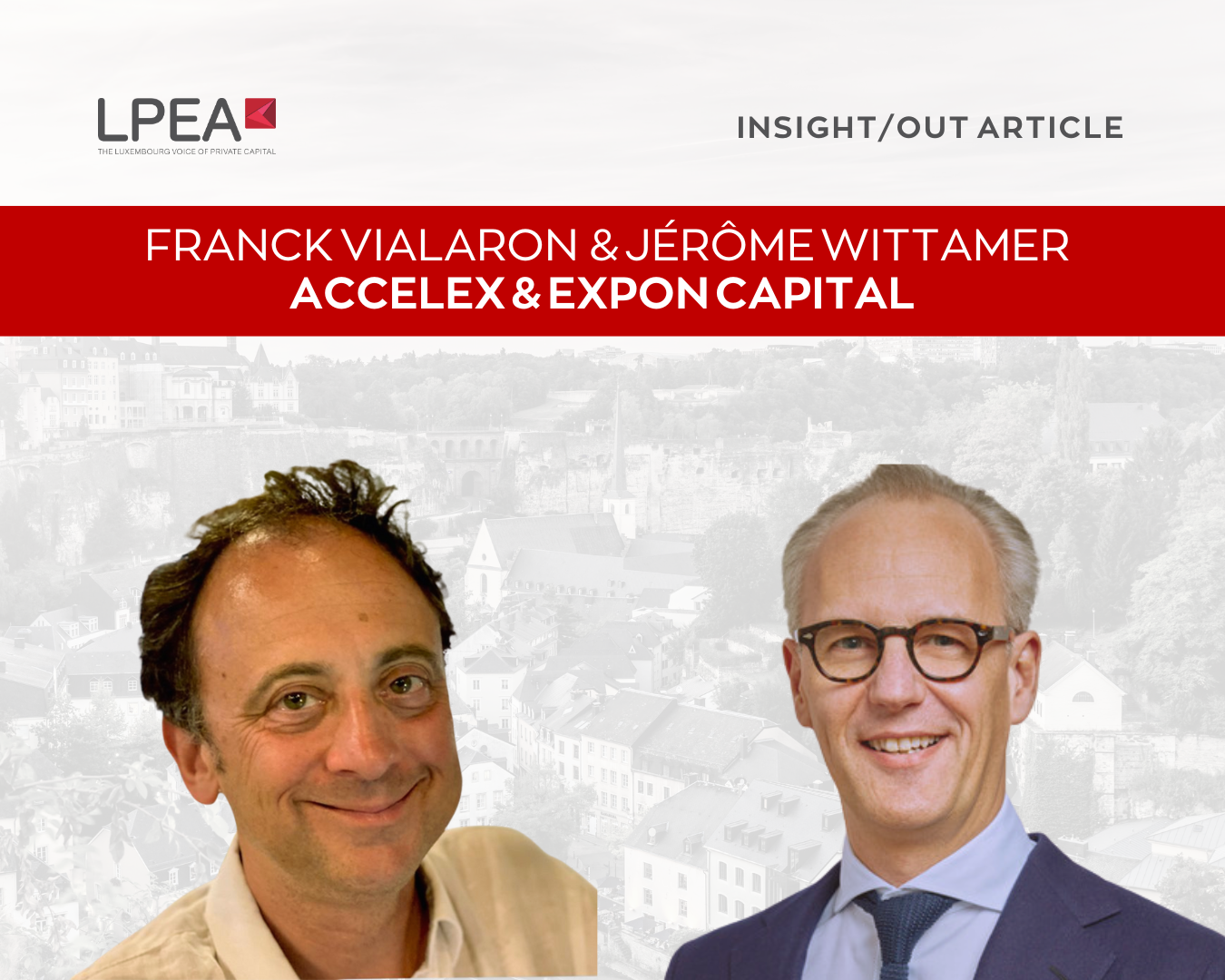
Article by Jérôme Wittamer, Partner Expon Capital and Franck Vialaron, CEO of Accelex, as published in Insight/Out magazine #36.
If you want to understand how Accelex began, forget the usual founder–VC mythology of pitch decks and boardrooms. Our story starts with a pizza. More precisely, a pizza at Ambiente in Strassen, just across from the CSSF, where Franck spent most of the meal asking questions… and Jérôme spent most of it not eating. Not because the pizza wasn’t good, but because Franck’s curiosity left no room for chewing. It was the first sign of a habit that would define the next five years: relentless inquiry on one side, quiet observation on the other, and a shared sense that something important was forming — even if none of us yet knew the full shape of it.
The goal was to build Accelex, a unique platform leveraging advanced NLP and machine learning to automate the extraction, analysis, and standardization of performance and financial data buried in unstructured private market documents provided to their Limited Partners (LPs) by General Partners (GPs).
What we did know was the paradox staring everyone in private markets in the face: an industry overflowing with capital, sophistication, and ambition… yet still operating on what Franck jokingly called the “Duck Tape & Prayers tech stack.” Trillions of dollars managed by LP people manually extracting data from PDFs. Analysts poring over documents late at night with Excel files named Final-Final-v7_DecReview(2)_REAL.xlsx. Legacy workflows held together by goodwill and color-coded cells. It was as if the Stone Age had collided with Big Finance.
What this new technology enabled for large LPs was a quantum leap in data analytics. By standardizing disparate documents into a unified, clean dataset, Accelex empowered institutional investors to move beyond simple data collection. They could now generate real-time portfolio-wide benchmarks, identify performance outliers, calculate key metrics like TVPI and DPI across their entire book instantaneously, and perform robust scenario analysis. This wasn’t just workflow improvement; it was the foundation for truly data-driven capital allocation and deeper manager due diligence, providing a competitive edge in an increasingly complex global private market. That was the vision Expon Capital underwrote.
Franck had lived this contrast for years. Early in his career, he’d seen investment banks transform themselves through automation, analytics, and electronic trading. They raced ahead, investing heavily because technology wasn’t just a cost center — it was an edge. Private markets, by contrast, remained frozen in time: sophisticated investors running billion-euro funds with tools that belonged in a museum. The more we talked, the more obvious the opportunity became: if you could unlock and automate unstructured private-market data, you wouldn’t just improve workflows — you’d modernize an entire industry.
Weeks later, the rest of the founding team met with Expon Capital’s team, and the picture sharpened. The three of them were an unusually well-balanced triad. There was Franck, the thinker — calm, analytical, always two steps ahead. There was Michael, the seller — a commercial machine who could go from GTM to partnerships to hiring without missing a beat. And then there was Nicole, the product mind, obsessed with understanding what customers really needed and delivering value that exceeded expectations. Individually, they were strong. Together, they were complete.
What struck us early on was not just the clarity of their vision but the speed with which they executed. Most early-stage teams build quietly, refine endlessly, and only then venture out to test the market. Accelex reversed the sequence entirely. They started selling before the product existed in polished form — not out of recklessness, but because they carried the credibility to do it. They met prospects almost immediately and signed early customers far faster than investors expected. Experience, reputations, networks — these were accelerants that first-time founders rarely have. It was one of those moments when, as an investor, you think: This is going to move fast.
Tech wise, the journey began with a long climb up a technical mountain. People often forget how brutal the challenge was in 2019 — pre-LLM, pre-modern NLP tools, pre-off-the-shelf data extraction. Automating and standardizing private-market data meant wrestling with documents that varied wildly in structure, content, and even writing style. There were setbacks, frustrations, experiments that led nowhere. But with each iteration, the product inched further away from manual processes and strongly outperformed in reliability, speed, and cost. Step by step, the team was dragging private markets out of the dark ages.
Along the way, we discovered a cultural divide that shaped the company’s trajectory more than we expected. Take one major European investor, for example — brilliant team, strong leadership, and a clear desire to modernize. They wanted automation, cleaner data, and better insights. The CEO was fully committed. Strategically, everything aligned. It still took twelve months. There were POCs, discovery phases, workshops, validation rounds, more workshops, layers of approvals, and then the slow, hesitant trickle of the decision through the organization. Leadership said yes. But middle managers were cautious. End-users were comfortable with their old workflows. Teams were busy, risk-averse, and not incentivized to adopt something new. And when the contract was finally signed, the classic European assumption kicked in: “Great. Tech acquired. Implementation will happen by itself.” Without sustained change management, adoption stalls. The value story that resonates at the top doesn’t always translate to the people doing the day-to-day work.
Now compare that to a large North American client. Six months from start to finish. Middle managers were the internal champions. They “sold up” to the CEO with concrete evidence of value, then “sold down” to users with clarity and enthusiasm. Quick wins created momentum. Adoption accelerated. Cross-selling began. And because the organization spoke with one unified voice, the product spread naturally across teams. Same industry, same problem, same solution — but two entirely different behavior patterns. This contrast was one of the biggest surprises of the journey, and one of the most important. The lesson? Building great software is one difficulty. Getting humans — across cultures — to embrace new ways of working is another entirely.
Not every chapter was smooth. At one point, an early M&A offer appeared — unexpected, tempting, and emotionally charged. The founders were open to exploring it; some investors felt it was premature. The tension wasn’t about disagreement but about timing and value creation. Jérôme approached it the way a VC should: supportive of the founders’ instincts, but clear-eyed about the long-term opportunity. Instead of pushing an agenda, he focused on helping the team evaluate the offer rigorously — what it meant, what it didn’t, and whether it truly maximized value for all shareholders. It was steady, principled guidance at a moment when emotions ran high.
Then came the LLM wave. Suddenly, every prospective client believed they could solve private-market data extraction by connecting GPT to a shared drive. Sales slowed. Excitement shifted to DIY fantasies. And yet the founders reacted with the exact blend of emotions that marks seasoned operators: annoyance (understandable), calm confidence (necessary), and immediate determination to leverage LLMs internally where they strengthened Accelex’s NLP engine, and leverage their deep expertise. It wasn’t a threat; it was just the next phase of evolution.
By the time discussions with Carta emerged (Accelex was acquired by Carta in September), the industry had entered a consolidation cycle. Large platforms were stitching together vast elements of private-market infrastructure. Remaining independent would have been bold — and expensive. Joining forces with a major player made strategic sense. Our reaction was simple: excitement and curiosity. And the fit was strong. Michael led the negotiation with precision, Franck provided ballast and long-view clarity. It was handled with maturity from start to finish.
Along the way, Franck tells Jérôme that a few investor-to-founder conversations proved truly meaningful. The push to pace investment and weigh cost of capital carefully became critical as markets shifted. And the encouragement to study how great AI companies scale — not linearly, but in waves — shaped how the team structured operations and roadmap. They didn’t just listen; they integrated. Eventually, the advice to commit to Luxembourg — operationally, not just symbolically — with Carta growing a full-fledged team.
Looking back, the journey taught us as much as it built. A complete founding team accelerates everything. Cultural differences between Europe and North America remain deeper than we admit. Calm execution during both hype cycles and fear cycles is invaluable. And Europe needs more founders who build boldly — and more investors who trust them early.
Above all, it was a story of partnership: thinkers, builders, sellers, and believers working together through setbacks, breakthroughs, cultural surprises, and one hair-in-the-soup moment. A story about dragging private markets into the present, one dataset at a time. And a story grounded in mutual trust, from founders to investors and back again.
For that trust — and for the privilege of building, learning, and growing together — we are deeply grateful.