Skip to content


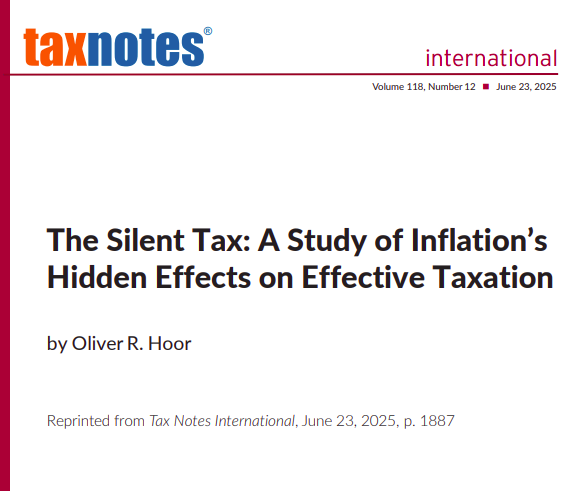
By Oliver R. Hoor, Tax Partner and Head of Transfer Pricing at ATOZ Tax Advisers Luxembourg, as published in Tax Notes International (Vol. 118, No. 12, 23 June 2025).
In this study, Oliver R. Hoor (ATOZ Tax Advisers) looks at how inflation acts as a hidden tax. Because tax rules use fixed nominal amounts, inflation pushes up the real tax burden through bracket creep, eroded allowances, devalued tax losses and tax on gains that exist only on paper.
The paper also covers what drives inflation and the limits of how it is measured, and it illustrates the effects with Luxembourg examples:
- Bracket creep: tax brackets that do not move with inflation mean higher rates, even when pay only keeps up with prices.
- Capital income exemption: the €1,500 tax-free amount was set in 2001; to keep its value after about 64% inflation, it would need to be around €2,465.
- Property gains: a company that bought property for €10m in 2010 and sold it for €14m in 2024 is taxed on a €4m gain, although the real gain after inflation is only about €420k.
- Currency gains: foreign exchange gains on loans are taxed at 23.87%.
- Measuring inflation: housing makes up only 11.2% of Luxembourg’s consumer price index, while the author estimates it accounts for 30–50% of household spending.
Tax losses, pensions, VAT, and wealth and property taxes are also covered.