Skip to content

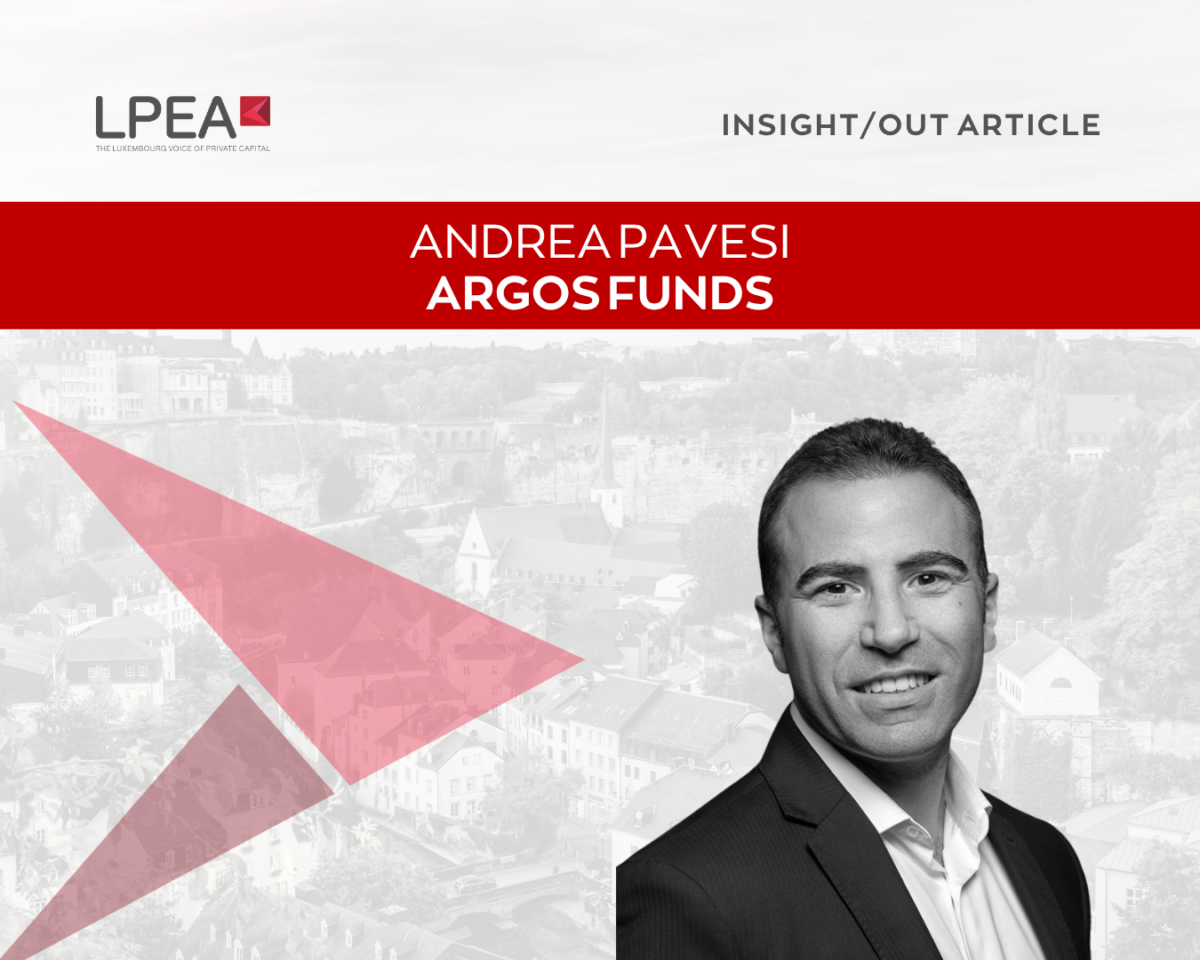
By Andrea Pavesi, Partner at Argos Funds as published in Insight/Out magazine #39.
AI is not about technology
When Artificial Intelligence is discussed, the conversation often starts with the technology itself: larger models, better tools, faster deployment. This perspective is incomplete. A century ago, electricity did not transform industries simply because factories were connected to the grid. It transformed them because businesses redesigned processes, products and operating models around what electricity made possible. Artificial Intelligence is following the same path. The technology is becoming increasingly accessible, but value will come from companies that know how to apply it.
Figure 1 – AI value creation is more than just technology
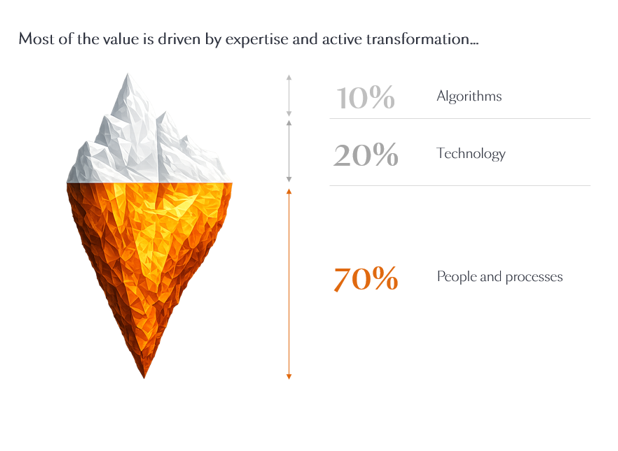
Source: From Potential to Profit: Closing the AI Impact Gap (BCG AI radar, January 2025)
Figure 2 – AI adoption
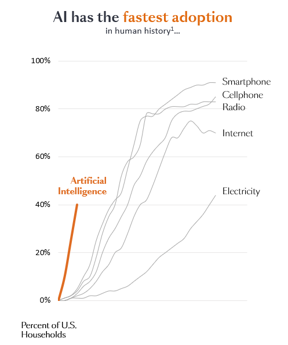
1. AI Diffusion Report: Where AI is most used, developed and built. Microsoft AI Economy Institute (November 2025)
For investors, this changes the challenge. The key question is no longer whether a company will use AI, but how AI will reshape its economics. Will it improve productivity? Transform the value proposition? Or disrupt the business model? Capturing that opportunity requires more than investing in technology. It means identifying where AI can create competitive advantage, redesigning workflows, adapting organisations and supporting execution over time.
European small- and mid-sized companies are particularly well positioned. They combine established operations, proprietary data and deep sector expertise with greater agility than many large corporates. Yet they often lack the capabilities and resources needed to turn AI into measurable outcomes. This is where investors can create value: helping management teams translate accessible AI technologies into differentiated products, stronger operations and more resilient business models.
From augmentation to transformation: looking beyond productivity gains
AI can affect a company at three levels. The first is augmentation: improving existing tasks, from analysing information to automating repetitive work. The second is transformation: changing how the company operates or what it delivers to customers. The third is disruption: reshaping market structures, lowering barriers to entry and commoditising activities that once required substantial human effort.
The response cannot be the same in every case. Augmentation may require targeted implementation. Transformation requires changes to processes, roles and the business model. Disruption may demand fundamental repositioning.
Applied AI: create value in a traditional surveillance business
Take the example of an SME providing integrated physical and digital security services. Its customers, from industrial sites to logistics platforms and corporate campuses, rely on it to protect critical assets and ensure business continuity. Every day, its Security Operations Centre receives tens of thousands of events generated by cameras, intrusion systems, access controls and cybersecurity platforms. Behind every alert lies the same question: does this situation require human intervention?
Traditionally, the value proposition of a security provider was built around monitoring infrastructure and dispatching the right response when an incident occurred. As customers deploy thousands of connected devices, simply processing more alerts or adding operators does not create more value.
Over recent years, AI has progressively been embedded into the company’s Security Operations Centre to correlate physical and cyber events, qualify alerts before they reach operators and learn from previous incidents. Instead of reviewing every signal, operators can focus on the few situations where human judgement is required.
This changes the service delivered to customers. Rather than paying mainly for surveillance, they increasingly receive a risk-management service capable of identifying weak signals, anticipating incidents and improving operational resilience. The value no longer comes from watching more cameras. It comes from making better decisions, faster.
Building this capability required more than deploying models. Procedures were redesigned, new workflows introduced, operators trained to use AI recommendations, and performance indicators redefined around service quality. Technology was only the starting point. Turning it into a differentiated proposition required genuine operational transformation.
Applied AI : navigate the SaaSpocalypse
Not every industry experiences AI as an obvious value-creation opportunity. In some sectors, it first emerges as a threat to the core business, carrying a real risk of value erosion. The recent “SaaSpocalypse” illustrates this dynamic. As generative AI makes software cheaper and easier to build, standalone features that once differentiated vendors risk rapid commoditisation. For many SaaS providers, the question is no longer whether AI will reshape the market, but whether they will lead that transformation or be disrupted by it.
Document and workflow management is one such industry. Customers rely on these platforms to manage business-critical processes such as invoice processing, contract approvals, electronic signatures and regulatory archiving. Traditionally, these solutions operated linearly: capturing documents, extracting predefined information and routing them to the next step. AI has now been embedded across product suites to handle the edge cases conventional automation could not process reliably, including unstructured documents, inconsistent formats and poor-quality scans.
Yet the real AI breakthrough goes beyond document recognition. Customers are no longer buying software merely to store and circulate files. They increasingly rely on broader ecosystems to execute critical processes faster, more reliably and with full regulatory traceability.
This changes the strategic positioning of document and workflow management providers. Rather than competing on easily replicable standalone features, they must become deeply embedded in customers’ daily operations. Durable differentiation is built not only through AI, but through three capabilities:
- Deep business expertise, to identify and solve friction points in enterprise operations.
- Regulatory knowledge, to ensure that speed never compromises legal or compliance requirements.
- Seamless workflow integration, to power daily, cross-functional processes.
This transformation does not happen by bolting an AI wrapper onto an existing product. It requires a deliberate redesign of the platforms’ architecture, robust AI capabilities and continuous adaptation to customer workflows. Technology is only the starting point. The real value comes from rethinking how the business serves, integrates with and protects its customers.
Financing AI application to build European champions
These examples point to a broader conclusion. The main challenge in AI value creation is not access to technology. It is application through orchestration and execution. Implementing a model or an agent is often the easier part. The difficult questions are strategic and operational: which customer outcomes should improve, which workflows should be redesigned, which roles will change, and how adoption and impact will be measured.
For European SMEs and mid-sized companies, the opportunity is significant. Their industrial know-how, proprietary data and sector expertise provide strong foundations for differentiated AI applications, while their agility allows them to redesign workflows faster than larger organisations. Their constraints remain real, particularly in talent, investment capacity and change management. This is where investors have an important role to play and a clear opportunity to create value.
For Europe, this is also a question of competitiveness and sovereignty. European companies may not control every layer of the global AI technology stack, but they hold strong positions in specialised markets and deep knowledge of their industries. Applying AI to these assets can strengthen customer propositions and create more resilient European champions.
As with electricity, value will come from application. The role of investors is to help companies make that application concrete, operational and scalable.