Skip to content

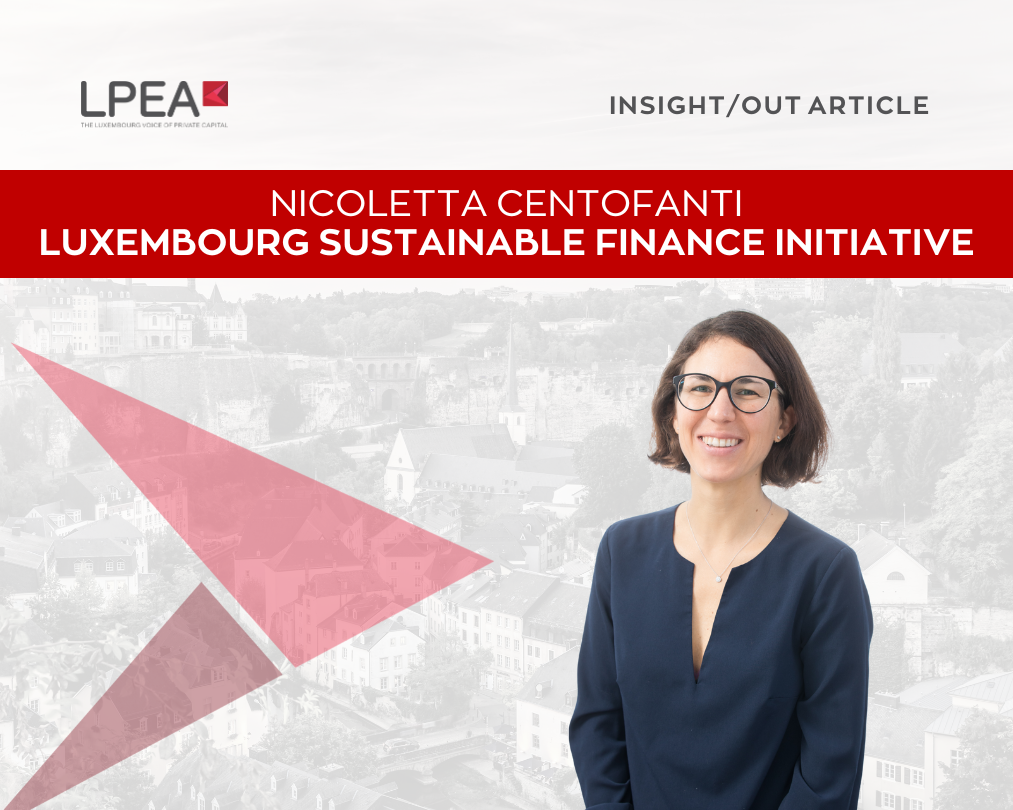
Article by Nicoletta Centofanti, CEO of Luxembourg Sustainable Finance Initiative, as published in Insight/Out magazine #35.
How sustainable finance has shifted from a nice addition to a business imperative
Sustainable Finance can be described as financial services used to fund the transition of the economy towards a more sustainable, just, and equitable future. In other words, it refers to financial decisions that not only seek financial return, but also consider their non-financial impact, which involves environmental, social, and governance aspects (ESG). However, can sustainable finance be considered merely a compliance exercise and an obligation to address today’s social and environmental challenges? It would be a mistake to do so, as sustainable finance stands as an opportunity for the financial sector to foster growth in the long term.
Sustainable finance should, though, be regarded as a priority. Not only is sustainable finance beneficial for the competitiveness, robustness, and resilience of the business, but it also brings benefits to recruitment across the finance sector, helping firms attract top talent[1].
It is equally crucial for anticipating risks, particularly those posed by climate change, which can lead to significant financial losses. A case in point: in 2024 alone, climate-related disasters cost the global economy $320 billion[2].
Sustainable finance also strengthens corporate reputation, builds market trust, and helps organisations differentiate themselves, especially as scrutiny over ESG initiatives grows. Indeed, public concerns over issues like greenwashing and labor abuse heighten the risks of reputational and financial damage. Evidence also shows that sustainable funds have outperformed traditional funds in recent years by a median of 4.7%[3], illustrating a growing investor interest in ESG-aligned investments – driven both by financial motivations and recognition of climate risks to portfolios.
It is therefore not surprising that over three-quarters of individual investors are interested in companies with both financial returns and positive social and environmental impact4. These benefits underscore the fact that investing responsibly is not only beneficial for the planet but it is also smart business.
Luxembourg: A Growing Sustainable Finance Hub
Luxembourg is a global leader in sustainable finance, consistently innovating and collaborating with the ecosystem’s players to accelerate the adoption of best practices. It is ranked among the top green finance centres worldwide, with the Global Green Finance Index (GGFI) placing it at the top for green finance penetration and quality[4]. Luxembourg is home to the pioneering Luxembourg Green Exchange (LGX), the world’s first and leading platform dedicated exclusively to sustainable finance, with 1.2 trillion EUR of green, social, sustainability, and sustainability-linked (GSSS) bonds issued through LGX securities[5], and accounts for 34% of European sustainable investment funds[6].
Additionally, leading sustainable finance organisations have spearheaded the transition to green finance:
- The Luxembourg Finance Labelling Agency (LuxFLAG) is the only agency in Europe that labels financial products across many different jurisdictions, offering a unique range of both impact labels and sustainability transition labels[7].
- Accelerating Impact powers the International Climate Finance Accelerator (ICFA) and International Social Finance Accelerator (ISFA), two programmes aimed to support impact investment managers developing strong, innovative climate and social investment strategies, and are in the process of fundraising[8].
- The Luxembourg-EIB Climate Finance Platform (LCFP) is a joint initiative between Luxembourg Government and the European Investment Bank to support investment in international climate finance by mobilising private sector investment, thereby acting as a catalyst for additional financing[9].
- The Gender Finance Taskforce (GFTF), led by the Ministry of Finance, fosters gender balance. Supporting Women in Finance is a key priority for Luxembourg’s financial ecosystem, whose objective is to become a Centre of Excellence in gender finance[10].
- The Luxembourg Sustainable Finance Initiative (LSFI) is Luxembourg’s coordinating entity on sustainable finance, whose mission is to build expertise among professionals and develop new opportunities to mobilise capital in sustainable investments[11].
Private Equity’s Role in Sustainable Finance
The Private Equity (PE) and Venture Capital (VC) ownership models create a direct link between responsibility and action for the investors. Climate change, regulatory developments, supply chain pressures, and evolving stakeholder expectations are no longer peripheral concerns, they are central to driving financial performance and mitigating associated risks.
ESG is also directly linked to exit value, since ESG factors measurably impact company valuations, exit strategies, and long-term value creation. Given the typical multi-year holding periods of both PE and VC, these considerations are no longer optional: they are strategic imperatives for value creation and risk management. An asset with poor ESG credentials is no longer seen as just operationally inefficient, but as a potential liability. Failing to address ESG requirements can result in lower exit multiples, longer holding periods, or even a reduced pool of potential buyers. This is particularly true in an environment where LPs, regulators, and public stakeholders expect demonstrable ESG performance as a prerequisite for investment.
The importance of ESG integration is not only theoretical. It is also clearly reflected in market data.
ESG private market funds domiciled in Luxembourg experienced an exponential compound annual growth rate (CAGR) of 95.2% between 2019 and 2023, reaching EUR 622.8bn and making up 36.5% of the total private markets AuM in 2023 – far outpacing the 11.7% CAGR recorded by non-ESG private market funds[12]. Notably, as of 2023, ESG PE funds managed €267.5 billion in assets under management, the highest share among all ESG private market strategies. By comparison, ESG infrastructure funds accounted for €188.9 billion, real estate funds for €107.7 billion, and private debt funds for €58.7 billion13. This clear appetite from investors to continue their efforts towards implementing ESG strategies is confirmed in the LPEA GP Survey of 2024, where it has been found that General Partners (GP’s) intend to strengthen their investment in ESG operations.
The growing involvement of PE and VC in sustainable finance is characterised by a combination of opportunities. PE is particularly well-positioned to deploy long-term, patient capital into sectors fundamental to the transition towards a more sustainable economy (renewable energy, sustainable infrastructure, and housing segments, for example) that remain less accessible to traditional debt instruments, particularly at early stages of development[13]. This evolution is driven by growing investor demand and the steady expansion of sustainable PE strategies in Luxembourg.
VC plays an equally vital role in advancing sustainable finance by channelling capital into early-stage startups that are often the source of breakthrough innovations. From climate tech and circular economy solutions to green mobility and energy efficiency platforms, startups are driving the development of next-generation technologies critical to achieving global sustainability goals.
Key Challenges and Opportunities
PE plays a central role in financing and developing companies by providing not only capital but also strategic and operational support. In doing so, PE investors often assume significant execution and operational risks, as they typically take ownership or control positions and actively manage portfolio companies.
In the context of sustainable finance, PE firms face persistent challenges. Chief among these are complex regulations, fragmented reporting frameworks, and difficulties in managing and interpreting ESG data[14]. According to the LSFI Report on ESG Data, the most common obstacle for private assets is accessing accurate and comprehensive information, particularly for SMEs. Data reliability is another issue, as financial professionals often rely on their own interpretation of incomplete or inconsistent disclosures. The absence of mandatory ESG reporting for SMEs, combined with a lack of standardised definitions and methodologies, limits comparability and inflates the cost of data collection. These challenges are compounded by budgetary constraints and resource limitations across firms[15].
The rapid evolution of ESG regulations further increases compliance complexity. While new initiatives aim to fill regulatory gaps, the proliferation of different standards creates uncertainty and scalability issues for the PE market.
Yet, these challenges also present opportunities. They encourage PE firms to strengthen collaboration with portfolio companies, develop clear internal evaluation frameworks, and ensure consistency in ESG measurement across investments. Building robust internal systems and integrating ESG data and reporting costs into fund structures are critical steps to improving transparency and resilience.
Stewardship, also called active ownership, has a key role in the management of ESG risks, as well as in guiding the investee companies’ sustainability journey, and is then a key driver for long-term value creation. For example, insights gained from engaging with investee companies can enhance investment decision-making processes.
Investor-related challenges remain, particularly for retail investors who face barriers tied to the illiquid nature of PE and limited diversification opportunities. However, the revised European Long-Term Investment Fund (ELTIF) 2.0 framework marks an important step in widening access to private sustainable investments. Additionally, recent reforms, including the removal of minimum investment thresholds, are expected to accelerate retail participation in PE, infrastructure, and real assets, driving the growth of the ELTIF market across Europe.
Collaboration and Innovation Beyond Regulation
The regulatory environment is evolving rapidly, driven by increasing investor demand for transparency and accountability. However, innovative initiatives are being taken to address these issues.
An important industry initiative is the Invest Europe ESG Reporting Guidelines, which is setting the industry standard for ESG reporting. In addition, the ESG Data Convergence Initiative (EDCI) harmonises a core set of ESG metrics for PE portfolio companies, improving comparability and consistency.
Besides regulatory reforms, there is a whole innovation wave emerging at the intersection of technology and sustainability, driven mostly by fintech. Fintech tools are streamlining ESG data collection, verification, and reporting, enhancing transparency and engagement across the investment lifecycle.
PE and VC offer the agility, resources, and influence to provide the fertile ground to turn ESG commitments into measurable progress. Now is the moment for stakeholders, investors, and innovators to seize this opportunity and channel capital where it can drive meaningful, lasting impact.
Strategic Next Steps for Investors in Luxembourg
Sustainable finance is increasingly recognised as a source of competitive advantage as ESG integration generates value while also protecting against financial risks linked to climate change, biodiversity loss, regulatory evolutions, and reputational issues.
In Luxembourg, the benefits of sustainable finance have been recognised early on, enabling the country to rise as a global hub. PE is a key driver of the real economy, providing capital for unlisted companies to grow, innovate, and create jobs while establishing stable governance structures. With its long-term investment horizon and active ownership model, the sector is uniquely positioned to advance sustainable finance by fostering meaningful impact, promoting more resilient business practices, and supporting broader economic and societal transitions.
[1] https://www.ey.com/en_us/insights/financial-services/how-financial-institutions-can-attract-and-retain-talent-with-esg-initiatives
[2] https://paperjam.lu/article/320-milliards-de-dollars-cout-des-catastrophes-climatiques
[3] Sustainable Reality 2024, Morgan Stanley Institute for Sustainable Investing
[4] https://en.paperjam.lu/article/luxembourg-keeps-slot-as-top-e
[5] https://www.luxse.com/discover-lgx, August 2025
[6] European Sustainable Investment Funds Study 2024, Association of the Luxembourg Fund Industry (ALFI)
[7] https://luxflag.org/luxflag-q1-2025-update-249-financial-products-now-labelled/
[8] https://www.isfa.lu; https://www.icfa.lu
[9] https://www.eib.org/en/publications/luxembourg-eib-climate-finance-platform
[10] https://gender-finance.com/
[11] www.lsfi.lu
[12] Sustainable Finance in Luxembourg 2024: A Maturing Ecosystem, Luxembourg Sustainable Finance Initiative (LSFI) & PwC
[13] Private Equity, Luxembourg for Finance (LFF)
[14] LPEA GP Survey 2024, Luxembourg Private Equity and Venture Capital Association (LPEA)
[15] ESG Data Outcome Report from LSFI’s Working Group, 2024, LSFI
[16] Sustainable Reality 2024, Morgan Stanley Institute for Sustainable Investing